Margin loans hit three-month high as market participants question effectiveness of regulators' response
As South Korea's stock market continues to swing sharply between steep losses and strong gains, questions are mounting over the effectiveness of financial authorities' response.
The Kospi, which plunged more than 7 percent on Thursday, edged up around 1 percent in early trading Friday.
The benchmark index closed at 5,668.05, up 2.05 percent from the previous session, after opening at 5,653.99, up 1.8 percent.
Meanwhile, the Kosdaq surged as much as 5 percent intraday, triggering a buy-side sidecar that temporarily restricts program trading.
Although both the Kospi and Kosdaq rebounded on Friday, market anxiety and uncertainty persisted. The Kospi 200 Volatility Index, widely regarded as South Korea's fear gauge, posted its third-largest daily gain on record, climbing to its highest level in about six weeks.
The Kospi had closed lower for seven consecutive trading sessions through Thursday.
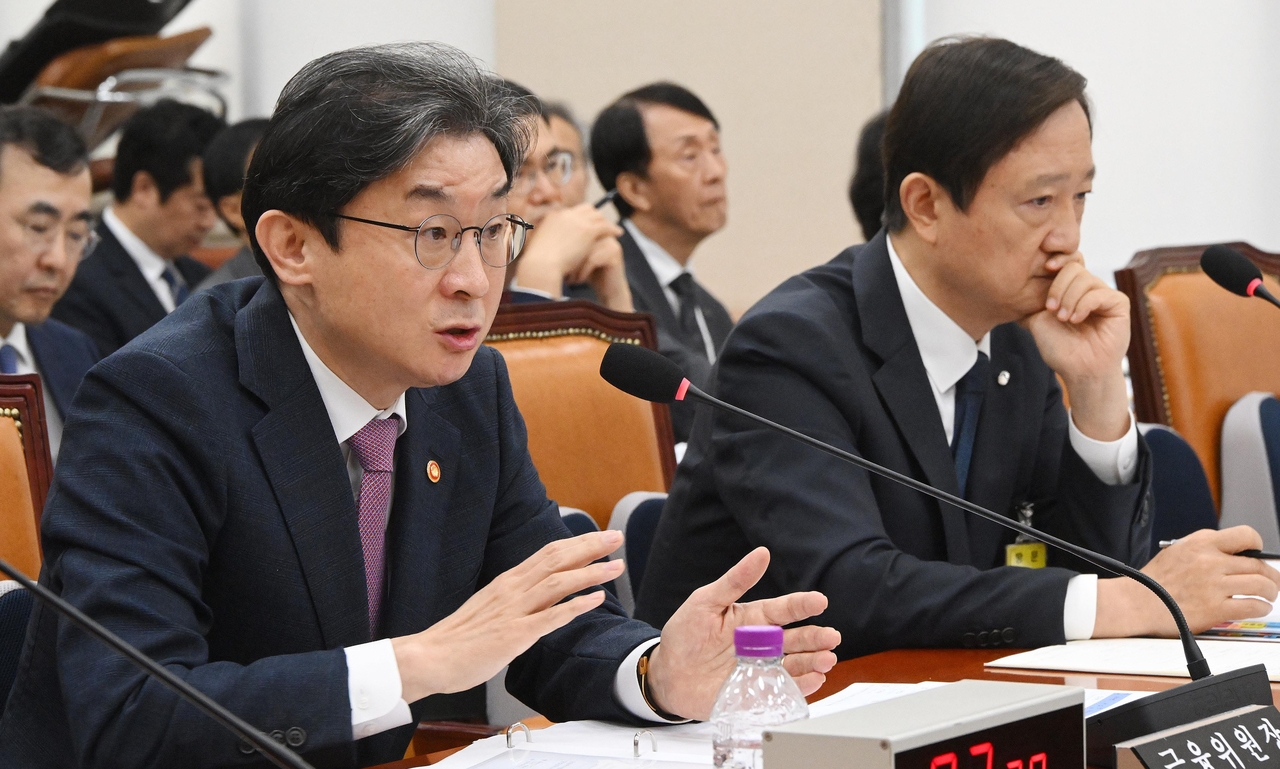
Amid repeated declines and sharp sell-offs, the Financial Services Commission held an emergency meeting with relevant institutions, including the Financial Supervisory Service, the Korea Exchange, the Korea Capital Market Institute and the Korea Financial Investment Association.
FSC Chairman Lee Eog-weon warned that excessive leverage and reliance on borrowed money to invest in stocks posed significant risks, stressing the importance of risk management during periods of market volatility.
"Financial companies should refrain from extending credit indiscriminately and make every effort to protect customers and manage risks," he said.
Meeting participants cited expectations of US interest rate hikes, uncertainty over investment returns in the artificial intelligence semiconductor sector and rising international oil prices as factors contributing to increased stock market volatility.
However, market participants questioned whether the authorities' response was sufficient to address the continued market turmoil.
During the recent sell-off, as the Kospi repeatedly fell below the 6,000-point mark and threatened to drop below 5,500 points, retail investors' reliance on borrowed money to buy stocks rose to its highest level in three months.
As of Wednesday, outstanding margin loans stood at 33.7 trillion won ($2.53 billion) and had remained above 30 trillion won for an extended period.
Meanwhile, investor deposits, which indicate how much cash retail investors have available to buy stocks, remained near recent lows.
The figures suggest that retail investors are increasingly relying on borrowed money to invest even as the domestic stock market has suffered steep losses in recent weeks.
"Once again, the meeting produced little beyond general statements. While signaling that regulators are closely monitoring the market may help ease investor anxiety, repeated meetings without concrete measures could lose their effect and even unsettle investors by signaling that the situation is serious," a market source said.
"Government meetings will not stop foreign investors from selling. If the same messages are repeated, the market may simply tune out the financial authorities until concrete measures are announced," the source added.
Another market source said the warning about excessive leverage should have come earlier, when leveraged bets on individual stocks were draining liquidity from the market.
ch0221@heraldcorp.com