 Jung Min-kyung
Since 2017, I have covered South Korea’s political and economic landscape as a reporter, with a focus on foreign affairs, inter-Korean relations and security.
As a foreign affairs reporter, I closely follow developments from the Ministry of Unification, the Foreign Ministry and the Defense Ministry, tracking shifts in diplomacy, military policy and North Korea’s evolving posture. My work focuses on the intersection of geopolitics, security and policy decisions shaping the Korean Peninsula.
Earlier in my career, I also reported on South Korea’s financial sector, covering banking, markets and regulatory developments—experience that continues to inform my understanding of how economic policy intersects with national strategy.
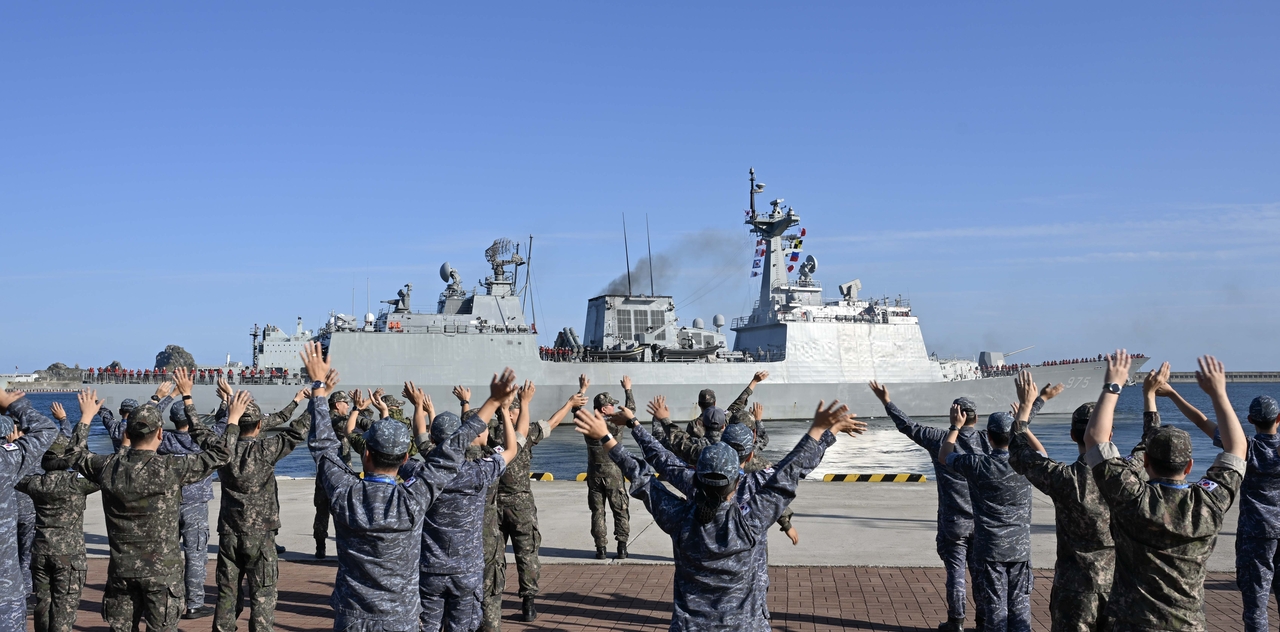
Defense Ministry cites worsening security conditions in Gulf of Aden as Cheonghae Unit's deployment mandate nears expiration
South Korea is weighing plans to bolster its Cheonghae anti-piracy unit with additional military assets, as maritime security threats mount in the Gulf of Aden, ahead of a likely request for parliamentary approval to extend the unit's overseas mission.
The Ministry of National Defense said Thursday that piracy activities in the Gulf of Aden off Somalia have increased sharply compared with previous years, heightening security concerns in the region where the Cheonghae Unit has been operating since 2009.
"It is true that the security situation in the Gulf of Aden off Somalia has deteriorated, with piracy activities increasing sharply compared with previous years," a ministry official said, requesting anonymity.
The ministry confirmed that the government was considering submitting a motion to the National Assembly to extend the unit's deployment beyond Dec. 31, when its current authorization expires, but stressed that no decisions had been made on the details.
"The Cheonghae Unit is carrying out its missions in the Gulf of Aden off Somalia in accordance with the deployment authorization, which is scheduled to expire on Dec. 31, 2026," the official explained.
"The government is considering submitting a motion to extend the unit's deployment before the current authorization expires, but no decisions have been made regarding the details."
According to military sources, the government is also reviewing ways to bolster the unit's surveillance, reconnaissance and defensive capabilities, including the possible deployment of a maritime patrol aircraft.
Among the options reportedly under consideration is the Navy's P-8A Poseidon, an advanced maritime patrol aircraft capable of conducting surveillance over large expanses of ocean.
The Cheonghae Unit currently consists of a 4,400-ton DDH-II destroyer, a naval helicopter, up to three rigid-hull inflatable boats and a contingent of up to 320 personnel.
Since its deployment in 2009, the unit has conducted anti-piracy operations and provided escort support for commercial vessels navigating waters off Somalia.
The possible reinforcement comes amid heightened tensions in the Middle East following the US-Iran war and the closure of the Strait of Hormuz, which has disrupted maritime shipping routes and raised concerns about the safety of South Korean vessels.
The Cheonghae Unit has reportedly provided long-distance escort support for South Korean oil tankers navigating alternative shipping routes through the Red Sea.
The government's review has nevertheless raised questions about whether strengthening the unit's capabilities could eventually lead to broader military involvement in the Middle East conflict.
President Lee Jae Myung ruled out sending South Korean troops or military assets to participate in the war during a Sept. 18 press conference, while indicating that the government could consider strengthening the Cheonghae Unit's existing role in protecting South Korean nationals and commercial vessels.
During a parliamentary audit Thursday, Rep. Son Sol of the progressive Jinbo Party urged the government to ensure that any reinforcement of the unit did not become a means of indirectly deploying South Korean forces to the conflict.
"Many people are concerned that strengthening the Cheonghae Unit's mission should not become a backdoor deployment," Son said, stressing that any expansion of military operations must receive parliamentary approval.
During a parliamentary audit by the National Assembly's Legislation and Judiciary Committee on Thursday, Defense Minister Kang Shin-chul addressed concerns that expanding the Cheonghae Unit's mission could effectively amount to an indirect deployment to the Strait of Hormuz.
"We are reviewing various aspects of the Cheonghae Unit's mission and the extension of its deployment," Kang told lawmakers.
His remarks echoed the Defense Ministry's position that no decisions have been made on expanding the unit's operational area or strengthening its capabilities.
Meanwhile, Rep. Kim Byung-joo of the ruling Democratic Party of Korea, who also serves as the president's special adviser on national defense, emphasized Friday that strengthening the Cheonghae Unit should not be interpreted as a military deployment to the Strait of Hormuz.
"This is absolutely not a deployment to Hormuz," Kim said during an MBC radio interview, reiterating that the president had ruled out any deployment involving participation in the Middle East war.
Kim argued that reinforcing the unit's defenses was increasingly necessary as piracy and other security threats continued to grow.
He said piracy activities in the Gulf of Aden had increased more than threefold compared with previous levels, while emerging threats, including drones, had exposed vulnerabilities in the unit's existing capabilities.
"During the most recent rotation of the Cheonghae Unit, we partially reinforced the destroyer's counterdrone systems, but its self-defense capabilities remain extremely vulnerable," Kim said.
He added that the unit currently relies on assistance from other countries' naval forces because its existing capabilities are insufficient to ensure its own defense.
Kim acknowledged concerns that reinforcing the unit could be mistaken for preparations to deploy forces to the Middle East conflict, saying the military was carefully weighing how to address such perceptions.
He stressed that any deployment extension proposal should clearly distinguish between strengthening the unit's existing maritime security missions and participating in the war.
Kim also suggested that the government would likely need to submit the extension motion by November to secure parliamentary approval before the current mandate expires at the end of December.
The Defense Ministry has maintained that the Cheonghae Unit continues to operate under its existing parliamentary authorization and that the details of any future deployment extension have yet to be determined.
mkjung@heraldcorp.com
- S. Korea weighs reinforcing anti-piracy naval unit amid rising maritime threats
- Seoul seeks to turn Trump-Kim summit into four-way peace talks: minister
- Audit of S. Korean envoys in US adds to doubts over US intelligence cooperation, response to NK mine blast
-
Seven injured in Bucheon factory fire
x
-
Mountain trail closed for nearly 60 years opens in Seoul
x
-
Incheon Queer Culture Festival wins first approval to use City Hall plaza
x