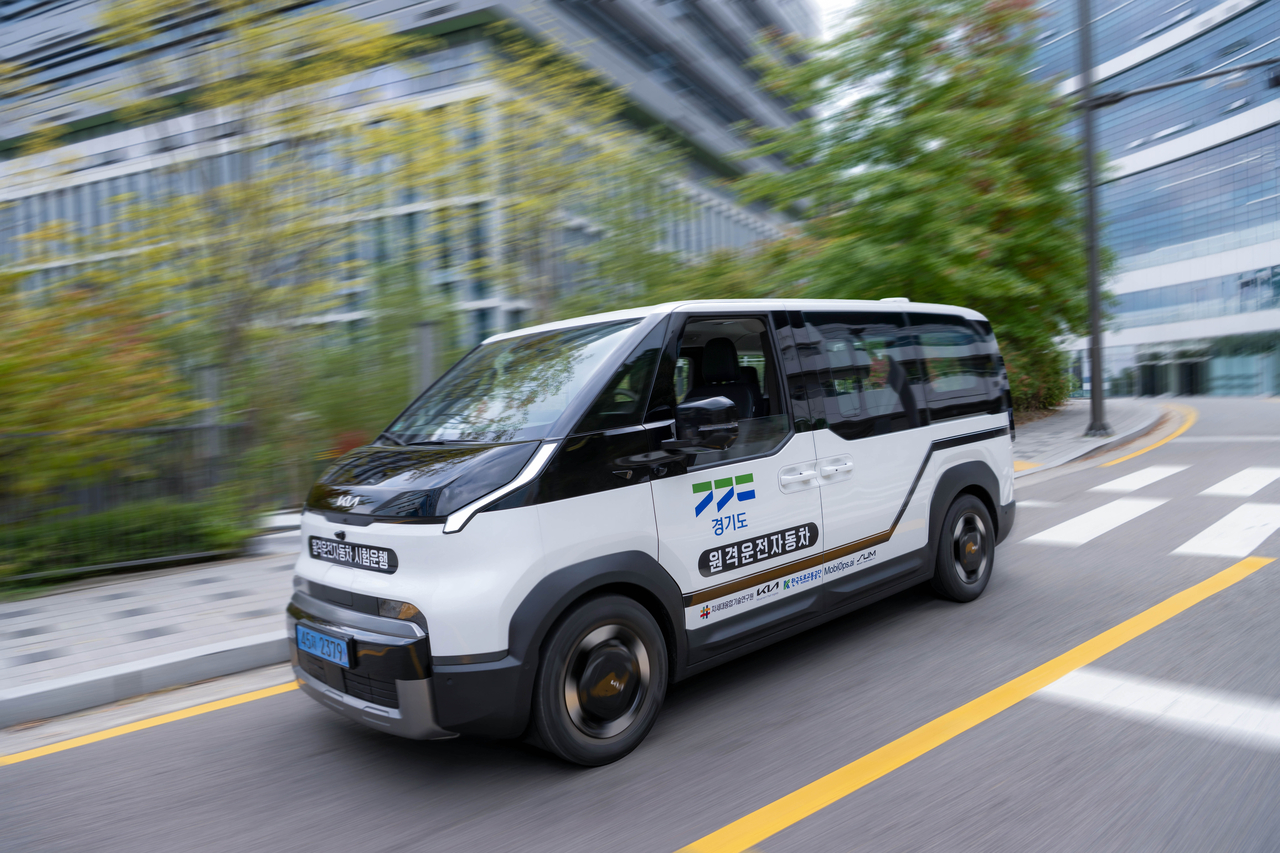
Kia has launched Korea’s first car-sharing trial using remote vehicle operation, aiming to assess its commercial viability and accelerate next-generation mobility solutions.
The program began Thursday for employees of businesses in the Second Pangyo Techno Valley, using its PV5 model. Operations will continue through the end of the year.
Customers reserve a vehicle through a dedicated app, prompting it to travel to their requested location without a driver. The customer then drives the vehicle to their desired destination and parks, after which a remote operator returns the car to its depot.
The arrangement can ease fleet management burdens for businesses while allowing users to avoid designated pickup and drop-off points.
The system enables operators at external centers to control unoccupied vehicles over 4G or 5G networks. Using existing telecommunications infrastructure and conventional vehicles can make it less costly than fully autonomous driving.
Kia received regulatory sandbox approval from the Ministry of Land, Infrastructure and Transport in April last year. In November, it joined Socar, KT and autonomous-driving startup SUM in field trials across Jeju and Hwaseong. The automaker signed a memorandum of understanding with KT and SUM in July this year to pursue commercialization.
The current initiative brings together Kia, SUM, mobility operator Mobiops and the Korea Road Traffic Authority. Kia provides the PV5 and oversees the project, while SUM develops the remote-driving solution. Mobiops manages operations and the Korea Road Traffic Authority handles regulatory reviews. Gyeonggi Province, KT and other organizations are also providing support.
To address connectivity failures, the consortium has established a triple-network system, alongside operator training and emergency response measures.
Kia plans to refine the technology using data gathered during the trial and expand the program in 2027.
“Remote vehicle operation can support not only car-sharing but also mobility support in areas with limited transport infrastructure and everyday convenience services,” a Kia official said. “We will continue developing new mobility offerings by combining purpose-built vehicles with this capability."
jyoungseon8@heraldcorp.com