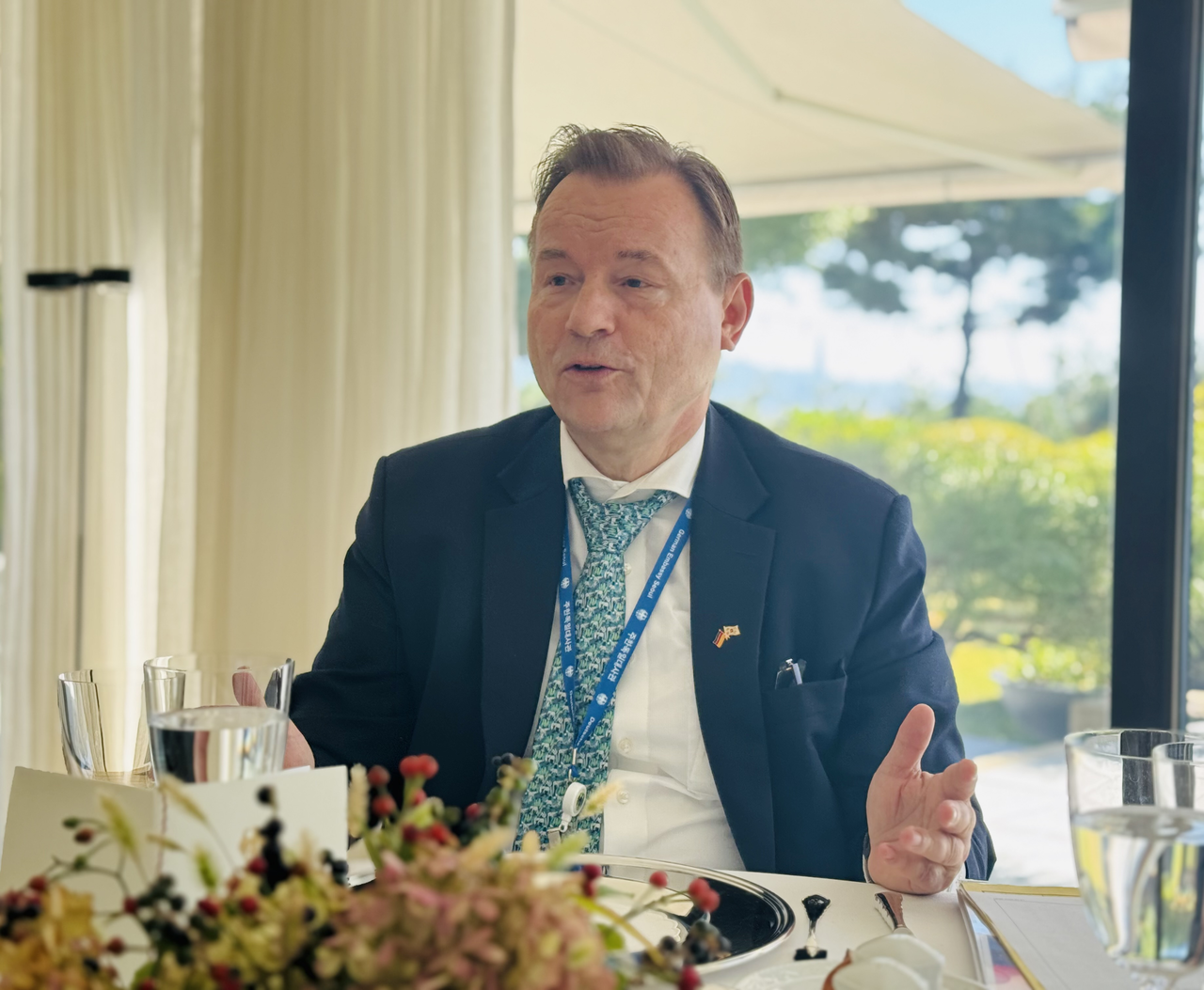
German envoy points to Korea’s role in exports, manufacturing ahead of Seoul conference
The Asia-Pacific Conference of German Business (APK) will strengthen business ties between Germany and South Korea, particularly in joint product development and industrial cooperation, according to Germany's ambassador to Seoul.
German Ambassador Georg Wilfried Schmidt told reporters Wednesday that companies from both countries were increasingly developing products together, building on established trade and manufacturing ties.
German Chancellor Friedrich Merz is scheduled to deliver a keynote speech at APK 2026, which is expected to bring some 800 business leaders and government officials to the Grand InterContinental Seoul Parnas on Oct. 29-31.
Schmidt cited South Korea's importance as an export market for German companies as one reason for choosing Seoul. Two years ago, Germany exported more to South Korea than to Japan, despite Japan's larger population.
“Many companies are now moving much more toward co-development,” he said.
Schmidt pointed to South Korean displays, batteries and other components used in German vehicles, as well as German suppliers making parts for South Korean automakers, as examples of integrated production networks.
The relationship now extends beyond competing for customers to supplying each other's factories.
Held every two years in different Asian countries, the conference will also draw executives operating across South Asia, Southeast Asia and Japan. Schmidt said the regional gathering would allow participants to compare business conditions and forge connections across markets.
“They do not come just for the program. They come for the networking,” he said.
The agenda covers industrial artificial intelligence, trade, raw materials, financing and the impact of political and economic disruptions on business. Naver CEO Choi Soo-yeon and Siemens President and CEO Roland Busch are scheduled to discuss industrial AI.
Beyond automobiles, Schmidt highlighted German involvement in South Korean manufacturing, including chemical producers, precision engineering firms and optical equipment makers supplying the semiconductor industry.
He acknowledged that high land and labor costs made South Korea an expensive manufacturing base, but said demand for specialized products and opportunities to work with South Korean manufacturers continued to attract German investment.
Such costs make access to customers and technical expertise key factors in investment decisions. Schmidt also called for greater attention to startups seeking business partners overseas.
On trade, Schmidt stressed the importance of stable conditions, citing the European Union's free trade agreement with South Korea, in place since 2011.
“What we can do is create stable trading conditions between other areas and regions,” he said.
He recalled concerns among automakers on both sides about increased competition as their markets opened further to each other.
German manufacturers feared competition from South Korean cars, while South Korean automakers expressed similar concerns about German brands.
Schmidt noted that Mercedes-Benz and BMW subsequently sold well in South Korea, while Kia and other South Korean manufacturers found buyers in Germany and elsewhere in Europe.
“Competition made both sides better,” he said.
sanjaykumar@heraldcorp.com