
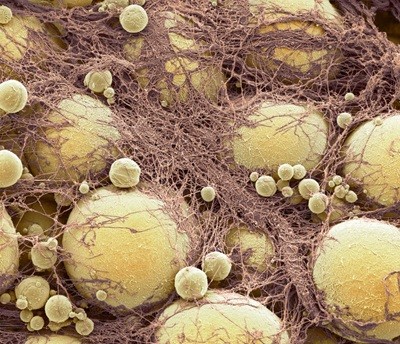
Brown fat (shown here in a light-microscopy image) burns calories to generate heat.Credit: Ziad M. El-Zaatari/Science Photo Library
When people think of fat, they typically picture the jiggly tissue around the belly that stores extra calories. That’s white fat. But there’s another type, called brown fat, that does the opposite. Typically found around the neck, armpits and in the chest, brown fat burns calories to generate heat and has been linked to health benefits.
Fat cells have a ‘memory’ of obesity — hinting at why it’s hard to keep weight off
A study of more than 100,000 people — the largest of its kind — is now expanding that list of benefits. It revealed that people with ‘active’ brown fat are less affected by a number of health issues, including type 2 diabetes, depression and anxiety, than are those without it. Researchers used an artificial-intelligence model to quantify, from scans, the participants’ active brown fat, which is fat that is ‘turned on’ and burning calories. They concluded that the more active brown fat people have, the greater the protection they have from disorders and diseases.
The findings were published today in Nature1.
“This is one of the most comprehensive and, probably, significant works in the field,” says Shingo Kajimura, a molecular biologist at Harvard Medical School in Boston, Massachusetts.
Because this is a retrospective study, more work is needed to prove that brown fat is indeed causing all these benefits, says Irfan Lodhi, a molecular biologist at Washington University in St. Louis, Missouri. “But it’s still a very interesting and surprising study,” he says.
Turning up the heat
Scientists have known for decades that brown fat burns calories to produce heat. The fat helps newborns to stay warm, and scientists thought it vanished after babies developed the ability to shiver. But in 2009, researchers reported brown fat in human adults for the first time2,3,4.

Why BMI is flawed — and how to redefine obesity
To map active brown fat in people, scientists use imaging techniques that highlight metabolically active tissue. They inject people with a type of radioactive glucose, and use a combination of positron emission tomography (PET) and computed tomography (CT) scans to reveal which tissues are taking up the glucose — highlighting where brown fat is activated.
These techniques are typically also used to diagnose and monitor cancer. So, a team led by Paul Cohen, a physician-scientist at The Rockefeller University in New York City, partnered with Memorial Sloan Kettering Cancer Center, also in New York, to obtain data from more than 100,000 people who had these scans while going through treatment there.