
Joni Mitchell performed her environmental anthem Big Yellow Taxi at the 1970 Isle of Wight Festival, which attracted around 600,000 people.Credit: Tony Russell/Redferns/Getty
The words of Canadian-American singer-songwriter Joni Mitchell’s 1970 environmental anthem Big Yellow Taxi will be echoing in the halls of the United Nations biodiversity conference (COP17) in Yerevan, Armenia, that begins on 19 October.
Don’t it always seem to go / That you don’t know what you’ve got / Till it’s gone / They paved paradise / And put up a parking lot.
“Nature is in freefall,” according to the Living Planet Report 2026, published on 7 October by conservation charity WWF. Between 1970 and 2022, the sizes of vertebrate wildlife populations that WWF research teams have been monitoring decreased by 73% (see go.nature.com/4zy2zxd).
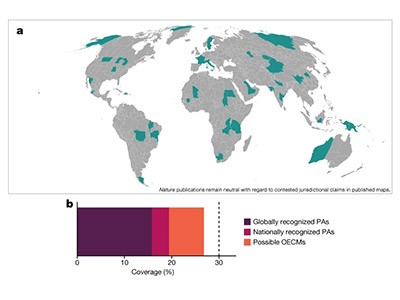
Lay of the land: terrestrial conservation efforts cover a wider area than thought
Almost four years ago at COP15 in Montreal, Canada, countries agreed on targets to stop and eventually reverse biodiversity loss by 2050. The goals included protecting 30% of land and water habitats by 2030 (also called the 30 × 30 target) and to substantially increase annual funding for conservation from public and private sources — to at least US$30 billion for low-income nations and small island states — by the end of the decade. Although these goals are not currently on course to be met, official figures could be underestimating the global amount of protected land, suggests a study published on 14 October (H. M. K. O’Neill et al. Nature https://doi.org/10.1038/s41586-026-11157-4; 2026).
The Living Planet Report notes that some species are no longer considered endangered — including the Atlantic bluefin tuna (Thunnus thynnus) and the green sea turtle (Chelonia mydas). But if the global decline in biodiversity is to be halted, a much more fundamental change is needed: the value of natural capital and ecosystem services must be factored into nations’ decision-making.
Many of the poorest countries that are rich in biodiversity rely heavily on international public and philanthropic funding to protect their natural resources. In Montreal, countries promised to mobilize at least $200 billion per year by the end of the decade. Some estimates suggest that the world has already surpassed that: global biodiversity finance trebled from roughly $100 billion in 2019 to around $300 billion in 2024, according to reports by the Paulson Institute, a think tank in Chicago, Illinois (see go.nature.com/3vuuvfz and go.nature.com/4yhgtuc). As of June 2025, 12 national and regional governments have contributed $386 million to a biodiversity fund for low- and middle-income countries. The fund currently supports 82 projects, including initiatives backing ecotourism in Indonesia and locally managed marine conservation in Madagascar.
The problem is that spending on activities that harm nature strongly exceeds the boost to biodiversity finance. For instance, it will now cost around $1.3 trillion a year to achieve the 30 × 30 target by 2030, suggests the Paulson Institute report. Moreover, several small but important biodiversity funds are struggling. For instance, the Cali Fund, which was launched last year, has received barely any donations so far. Companies that profit from using genetic-sequence data gathered in biodiversity-rich nations are encouraged to pay into this pot. As of now, businesses have contributed a grand total of $6,000.

Biodiversity conservation has an evidence problem — it’s time to fix it
Some economists say that to save nature, the world can’t rely on public funding or voluntary contributions from businesses. Government aid to low- and middle-income countries dropped last year by 23% compared with 2024, according to the Organisation for Economic Co-operation and Development. Researchers are instead proposing that countries cut public subsidies that harm nature and that they end or reform environment-damaging policies.
In its State of Finance for Nature 2026 report, the UN Environment Programme estimates that public spending on fossil-fuel subsidies exceeded $1 trillion in 2023 (see go.nature.com/3trvr2y). As well as harming nature, such subsidies can be counterproductive, too. Many governments, for instance, pay farmers to use pesticides that reduce the biodiversity needed for agriculture to be productive.
But cutting subsidies and even reforming them is difficult. Governments use subsidies to support businesses and protect jobs. Financial aid, including for energy and food, is also used to keep prices down for households when the cost of living is increasing.
China and many European countries are making progress by tying farm subsidies to environmental objectives, such as improved soil health, or by paying farmers to plant hedges and wildflowers. But these initiatives are in their early stages, and implementation is patchy.

Don’t rush rules for sharing digital genetic-sequence information
If aid is faltering and redirected subsidies won’t bridge the biodiversity-funding gap, something else needs to happen. Researchers argue that the people who run their nation’s economy — the ministers of finance and their teams — should be factoring the true costs of nature into their decision-making.
If, for example, a local or national government plans to convert part of a wetland for industrial use, any projections of economic benefits should be compared with the services provided by wetlands that will be lost, such as wildlife habitats, water purification and carbon sequestration. If bee populations decline because of habitat loss, their pollination services — crucial to human survival — will be lost. However, the cost of replacing such services is rarely factored in when land is converted.
For some years, China’s decision makers, together with the Natural Capital Alliance, a multidisciplinary team of researchers in China, Europe and the United States, have been studying how to incorporate such analyses into the country’s economic and industrial policies, using a concept called gross ecosystem product. Such an approach needs to be adopted by policymakers in other countries, too.
As long as countries regard ecosystems as being cost-free, they will always need appeals to altruism to protect nature — appeals that are increasingly failing. It’s encouraging that finance ministers are expected to join their environmental counterparts at COP17. Achieving the Herculean task of protecting ecosystems and biodiversity requires the world to change how it values nature.
Mitchell’s words should not become a self-fulfilling prophecy: make sure we protect nature, because “you don’t know what you’ve got till it’s gone”.