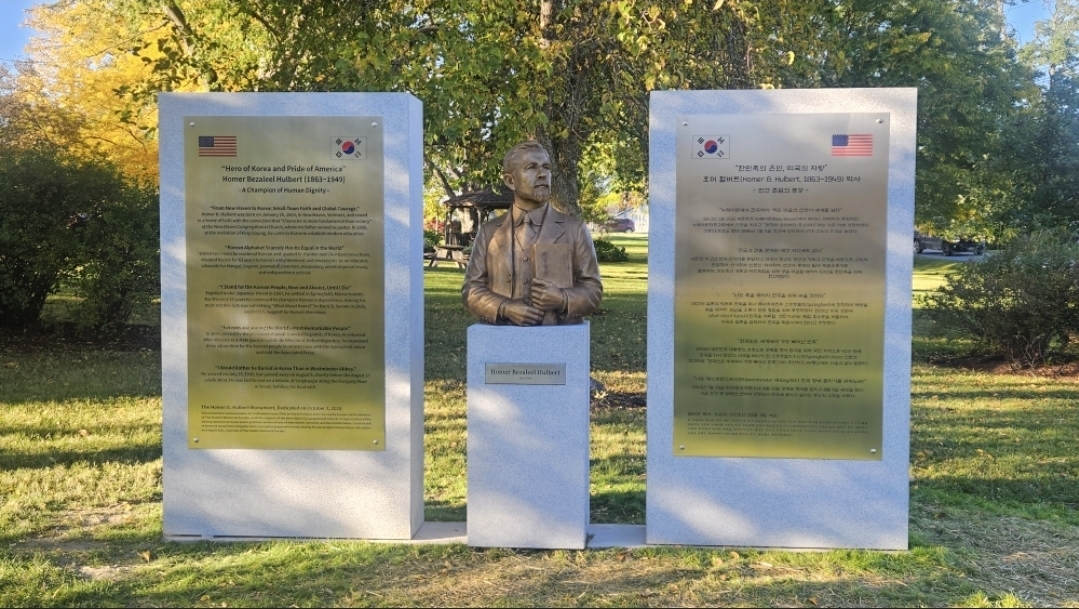
A monument and bust honoring Homer B. Hulbert (1863-1949), an American missionary and educator who championed Korea's independence, were unveiled in a ceremony on Oct. 3 in his hometown of New Haven, Vermont.
The Hulbert Memorial Society held the ceremony at Village Green, the former site of New Haven Congregational Church, where Hulbert worshipped as a child and his father served as the second pastor.
The monument stands 2 meters tall and 1.1 meters wide, with inscriptions in both English and Korean. The front honors Hulbert as a "Hero of Korea and Pride of America" and a "Champion of Human Dignity," and features some of his notable quotations and achievements.
The 1.8-meter bronze bust, including its pedestal, was created by sculptor Kwon Chi-gyu, who donated his work to the project. The stone used for both pieces was sourced from Vermont, while the inscriptions and bust were produced in Korea and transported to the US.
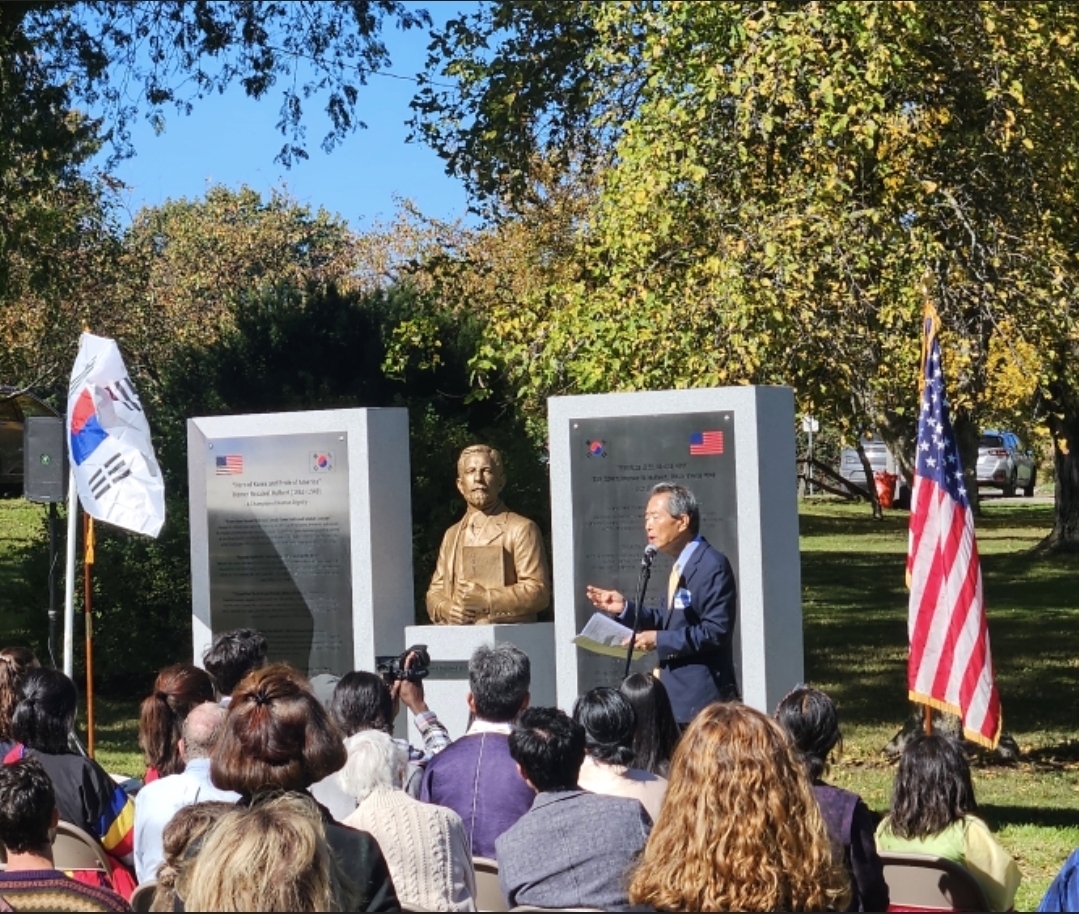
About 120 people attended the ceremony, including Kim Dong-jin, chairman of the Hulbert Memorial Society; Kwak Jeong-yeol, deputy consul general at the South Korean Consulate General in Boston; Ruth Hardy, Vermont state senator; Jubilee McGill, Vermont state representative; and a representative of New Haven. Six of Hulbert's descendants, including his great-great-grandson Kimbal Hulbert, also attended.
The memorial society funded the project through its own resources, including donations, without government support.
"Despite all that Hulbert did for Korea and the love he showed for the country, there had been no memorial in his hometown or anywhere else in the United States to honor him," Kim said at the ceremony.
"With the monument and bust now in place in his hometown, I feel we have begun to repay that debt, at least in some small measure."
Hulbert arrived in Korea in July 1886 to teach at Yukyeonggongwon (Royal College), the Joseon government’s first modern school. He went on to publish books, academic papers and articles on Korean language, history and culture, while drawing international attention to the injustices of Japanese colonial rule in Korea.
Shortly before Japan forced Korea to sign the 1905 Eulsa Treaty, stripping it of its diplomatic sovereignty, Hulbert traveled to the United States as a special envoy of Emperor Gojong. He was tasked with delivering a personal letter from the emperor to US President Theodore Roosevelt, the original of which was discovered recently.
In recognition of his contributions, the Korean government posthumously awarded Hulbert the Order of Merit for National Foundation, Independence Medal, in 1950, and the Gold Crown Order of Cultural Merit in 2014.
In a message on behalf of Vermont, Gov. Phil Scott thanked the organizers for honoring Hulbert and funding the monument in his hometown.
"This tribute recognizes a Vermonter whose life's work helped shape the relationship between the United States and the Republic of Korea," Scott said.
Hulbert traveled to Korea as a young man to teach but went on to become a respected scholar and advocate for the Korean people, Scott said. He spent much of his life sharing Korea's history and culture with the world and supporting the Korean people's pursuit of independence.
"It's remarkable that someone from a small Vermont town could have such a lasting impact on a nation so far away. Today, Hulbert is remembered in Korea for his contributions, and this monument will keep his memory alive in his home state as well," Scott said.
hwangdh@heraldcorp.com